

Why Spreadsheets Are Quietly Breaking Your Payroll (And How to Fix It)
Manual time tracking and disconnected spreadsheets create subtle errors that cost companies thousands every payroll cycle. Here is why unifying your attendance and payroll stops the leak.

Waseem Saleem
· 2 min read
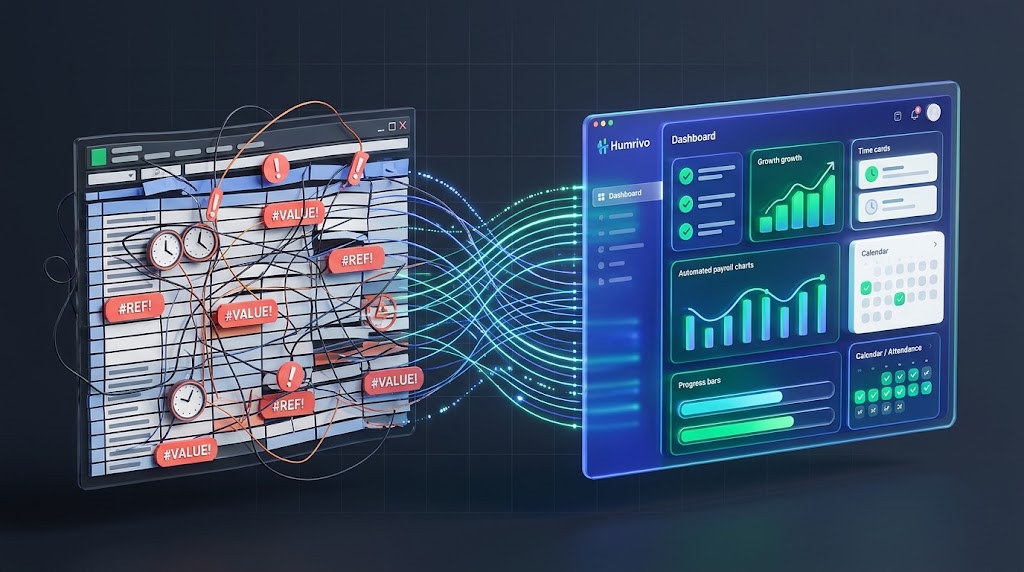
Every growing company starts with spreadsheets. They are flexible, free, and familiar. When you have five employees, tracking hours on a shared sheet and calculating totals manually works just fine.
Then the team grows to fifteen, thirty, or fifty.
Suddenly, that straightforward spreadsheet turns into a fragile maze of broken formulas, copy-pasting across tabs, and manual cross-checks. What once felt like a lean setup quietly becomes a major operational bottleneck.
Here is why manual payroll tracking breaks down as your business expands, and what a modern workflow looks like instead.
1. The Real Cost of "Spreadsheet Drift"
The biggest issue with spreadsheet-based HR is not just the manual work—it is data drift.
When your attendance tracking, leave requests, and payroll records live in separate files (or separate software tools):
Overtime calculations get missed or misapplied: Rules around shift differentials, weekends, or daily overtime require manual calculation, leading to inconsistent payouts.
Unapproved leave slips through: If a manager approves time off via email or chat, but the spreadsheet is not updated immediately, the employee may be marked absent or double-paid.
Version control collapses: Multiple managers editing different copies of an attendance sheet inevitably leads to overwritten data and lost corrections.
Even a modest 1% error rate on monthly payroll compounds into thousands in lost revenue or compliance penalties over the course of a year.
2. The Clock-In to Payroll Disconnect
When employee attendance lives on one system (or paper timesheets) and payroll is processed in another, someone has to act as the human bridge.
Every pay period, HR or operations managers spend hours:
Exporting raw clock-in data.
Cleaning up duplicate or missing timestamps.
Manually mapping hours to hourly rates or salaried allowances.
Manually re-entering figures into a payroll calculator or bank file.
This handoff is where errors happen. When attendance and payroll operate inside a single unified system, the hours clocked by your team feed directly into payroll rules. No intermediate spreadsheets, no manual transcription, and zero guesswork.
3. Transparency Builds Team Trust
Payroll discrepancies directly impact team morale. When an employee receives an inaccurate paycheck due to an unlogged shift or a miscalculated leave deduction, correcting it requires off-cycle adjustments, manual vouchers, and unnecessary friction.
A transparent, unified HR platform provides:
Clear visibility for employees: Team members see their logged shifts, approved leaves, and calculated balances in real time.
Accurate records for managers: Approvals happen in the flow of work, creating an audit-ready trail without hunting through chat threads.
Frictionless pay runs: When payday arrives, the numbers already match what was worked and approved.
Moving Beyond the Spreadsheet
Moving away from manual sheets does not require heavy, complex enterprise software that takes months to implement. It simply requires connecting the dots between when your team works, when they take time off, and how they get paid.
By unifying employee attendance, leave management, and payroll calculations into a single workflow, you eliminate repetitive data entry and ensure your payroll runs accurately every single time.
Ready to streamline your HR operations? Explore how Humrivo connects attendance, leave, and payroll into one unified system.
Would you like to adjust the tone or expand any specific section (such as multi-client billing or leave policy automation) before publishing?
Keep reading

Payroll software vs manual payroll: which to choose
Compare payroll software vs manual payroll to decide when to switch. Learn cost, compliance, operational and security trade-offs and a short decision checklist.
Waseem Saleem6 min read